Pixiu Dragon

Pixiu (also called Pi Xiu or Pi Yao) is a Chinese mythological creature . He is the ninth son of the Dragon King and one of the five animals of traditional Chinese culture. The Chinese call him the "beast of fortune." He brings happiness and luck to those who worship him. 🍀
Pixiu is fierce and powerful by nature. As such, he is tasked with patrolling the skies to ward off demons, ghosts, plagues, and diseases. Pixiu has a mouth, but no anus; he swallows without expelling anything. He is considered a divine being who collects wealth. 💰
Despite its ferocity, it is said to have a strong will to protect its master . This is why many people carry it with them as a talisman . Let's discover together its place in mythology, its history in Chinese culture, and its role in feng shui.

Pixiu in Chinese mythology
In Chinese mythology, Pixiu is the ninth son of the Dragon King. His diet consists of gold, silver, jewels, and precious metals. This gives Pixiu a noble character that earns him the love of both the Jade Emperor and the Dragon King. 🐉
Legend has it that Pixiu gorged himself so much at a banquet that he couldn't control himself and defecated in the Jade Emperor's palace. Furious, the Emperor punished him with a violent kick in the rear, forcing him to restrict his food intake and sealing his anus forever.
Pixiu has a voracious appetite and cannot stop eating; it stores all the riches it swallows in its stomach. This is why Pixiu is considered a lucky animal , attracting wealth and prosperity. It also helps people suffering from bad feng shui.

The story of the Pixiu dragon
Pixiu animals originated during the Han Dynasty (206 BC to 220 AD). They are mentioned and were originally called "táo bá" in the Book of Han, an ancient written account of Chinese history. The Book of Han was completed in 111 AD. Pixiu are mentioned in chapter 96 alongside other animals such as lions and rhinoceroses.
In homage to the legends recounting their ferocity and prowess in battle, the Pixiu became the symbol of the army in ancient China. The word "Pixiu," interpreted as meaning " fierce beast " and " brave warrior ," was used as an emblem on flags and war banners.
In ancient China, Emperor Wudi of the Han Dynasty declared that the marvelous, magnificent, and devoted Pixiu, which obtained and guarded its master's gold, would forever be known as the " Emperor's Treasure ." The Emperor asserted that only royal families could possess a Pixiu and that it was strictly forbidden for anyone else to own one. This law remained in effect until the end of the Qing Dynasty.

Pixiu in Chinese architecture
Throughout Chinese history, Pixiu were commonly used in traditional Chinese architecture to ward off Yin Qi (陰氣, negative energy) and to control auspicious Qi. Stone statues of Pixiu (bixie) were also placed as guardians of the tombs of Han Dynasty emperors and other royal figures. ⚰️
Generally, statues of Pixiu are found at the four corners of rooftops, houses, palaces, and imperial halls. Pixiu sits behind the dragon, the phoenix, the winged horse, the seahorse, and other similar creatures, in order to protect them.

Pixiu Features
The name of this mythical creature is pronounced "Pixiu" in Chinese. It is a divine animal from Chinese mythology. Pixiu has the head of a dragon, the body of a horse, and the paws of a Qilin; its physical appearance is comparable to that of a lion. 🦁
Pixiu has a beard under his chin and wings that grant him the ability to fly. He is capable of drawing wealth from all directions. Pixiu ingests food but does not defecate because he has no anus. He symbolizes luck and good fortune in homes and businesses.

Generally, three materials are used to carve Pixiu: copper, wood, and jade. Copper is an inexpensive material that resembles gold after polishing. Wood was traditionally used for carvings placed on the beam of a large house to ward off bad luck. In recent years, different types of jade have been used in Pixiu designs. 💎
What is the role of Pixiu in Feng Shui?
Tradition holds that once you own a Pixiu, it helps you attract and accumulate wealth . This is why it is considered one of the most popular elements in feng shui. Pixiu also have the power to protect their owner from calamities and dangers . If placed in the home, it helps to subdue all evil and serves as a protective guardian to safeguard the house and its occupants.

There's an old saying about this Chinese dragon that goes: "Touch Pixiu once and you'll have good luck, touch it twice and you'll get money, touch it a third time and you'll gain power (privileged status/promotion)." 😉
Placement of Pixiu in feng shui
Regardless of the material it's made from (wood, copper, or jade), Pixiu possesses the same power: to attract good fortune. Traditionally, according to feng shui experts, copper Pixiu placed in the eight directions (feng shui diagram) are considered the most powerful. ☯

One of the Pixiu's unique characteristics is that if its owner breaks the law, they will no longer be able to benefit from its help. There are also some restrictions regarding where to keep a Pixiu in your home; we advise you to follow the guidelines below if you adopt one:
- In addition to facing the area outside your main door , it's also good to position it so that it faces the space outside your windows . But don't turn Pixiu's head towards the front door, as that's the domain of another god.
- Do n't place it in your bedroom , especially facing your bed. This mythical creature is said to leap forward aggressively to collect wealth energy wherever it is. If you have a Pixiu facing your bed, it will affect the quality of your sleep. 🛏️
- Do not place it opposite the toilet , as this is an unsuitable place for Pixiu due to the dirt and smells.
- Do not place it in a place higher than your head , as this symbolizes that Pixiu will intimidate its master.
- Do n't put banknotes in his mouth , it's disrespectful. Pixiu isn't attracted to paper money, he only likes real gold and silver.
- Do not place it in front of a mirror , the reflections of the light will make Pixiu nervous and that means you intend to chase it away.
- Bonus: Do not touch the eyes and mouth of this celestial beast without reason, for Pixiu uses them to seek wealth.
Pixiu: the lucky animal
Now you know all about the Pixiu dragon ; you know it's a Chinese mythological creature that absorbs and stores wealth within itself. The symbolism of the Pixiu continues to resonate through the ages. You can adopt a lucky Pixiu ; it will discreetly accompany you. 💍
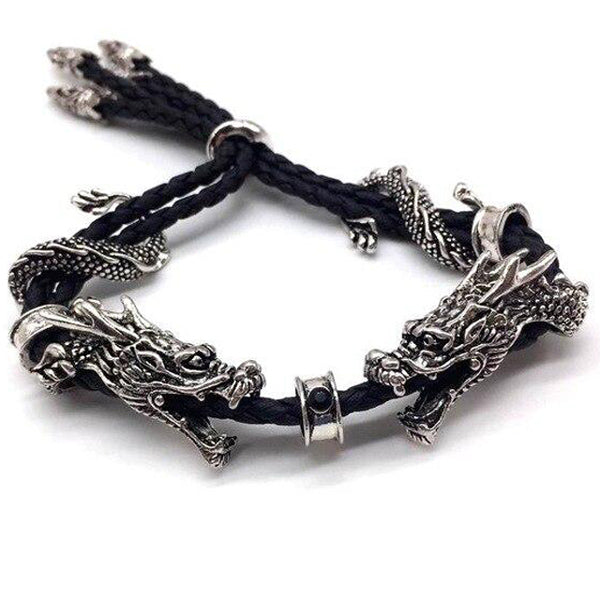
Besides figurines and sculptures, you can also wear the Pixiu as an amulet in the form of jewelry. The same instructions apply: remove it when you sleep or bathe. Below you'll find the fabulous Pixiu ring adorned with benevolent inscriptions. 👇