Dragons among the Vikings

To your swords and shields, blow your horns, dear Viking warriors, the hour is grave! Today we're taking on Viking dragons . Fear not, in the worst-case scenario we'll join Odin in Valhalla . More seriously, in this article we'll explore the many mysteries surrounding the Viking people and dragons. 🐉
From ancient times, the dragon was an important creature and symbol associated with Norse mythology. Later, it was incorporated and described in the folk tales of the Scandinavian countries. Dragons were mentioned and depicted in various legends, sagas, chronicles, and skaldic poems during the High Middle Ages, both in Iceland and Denmark. Among the epic literary works of this period that describe in detail the role attributed to dragons in Norse mythology are:
- The Völuspá : this is one of the earliest and best-known poems written in Old Norse.
- The Völsunga saga : this is a series of famous Scandinavian legends recorded in literary form in medieval Iceland and in rock carvings in present-day Norway, Sweden and England.
- The Deeds of the Danes (Gesta Danorum or Historia Danica in Latin): this is a 12th century chronicle written by Saxo Grammaticus which recounts the history of the Danes.
Keep in mind that the image of the dragon in Norse mythology is different from the one we have today. Let's delve into this history and discover together the meaning of the dragon among the Vikings. ⚔️

The Meaning of the Dragon among the Vikings
If you're a big fan of dragons and Norse mythology, let me explain the meanings and symbolism of the Viking dragon . This fabulous creature has long been known as the most powerful mystical being in Norse mythology. They are famous for their splendid and often terrifying appearance. Furthermore, they are characterized by extraordinary feats that words can hardly describe.
The Norse dragon is described as mysterious , powerful , and majestic . In Viking mythology , the dragon is a dangerous and unpredictable creature whose exploits and abilities cannot be ignored. Viking warriors embraced these attributes and embodied the characteristics of this ferocious beast. For the Danes, the dragon was a protective guardian and the symbol of the King. 👑

The Vikings were very likely aware of the dragon's power and symbolism. Illustrations of dragons can be found on buildings, engravings on runestones, and jewelry featuring the Viking dragon. The dragon, or serpent, was considered a symbol of strength and bravery . Wearing a dragon motif would therefore symbolize valor , audacity , and ardor for these ancient Scandinavian warriors. 🛡
The Viking dragon symbol also served to ward off beasts and creatures with vile intentions. The Viking dragon could thus offer additional protection to Norse warriors. This may explain why the dragon was so prevalent on everyday objects and continued to be used even into the early Christian period in Scandinavia.
The Viking Dragon in Norse Mythology
As an important element of Norse mythology, the dragon has always been representative of Viking culture . The Vikings had many stories of dragons and giant serpents that they bequeathed to their art. Some Viking dragons were not just giant monsters; they were cosmic forces in themselves. The most famous Norse dragons are:
- Nídhögg (Níðhöggr in Old Norse): A dragon that devours the roots of Yggdrasil, the tree that maintains the cosmos between the nine worlds.
- Jörmungand (Jǫrmungandr in Old Norse): A huge dragon that encircles the world and bites its own tail.
- Fáfnir : A dwarf afflicted by a curse, who transforms into a dragon in order to protect his cursed treasure.
A true predator par excellence, in mythology the Viking dragon represents both great power and great danger . They can sometimes symbolize spiritual corruption or the dark side of human nature. Above all, Viking dragons embody the destructive phase of the creation-destruction cycle. This means they evoke chaos and cataclysm , but also change and renewal.

The Dragon Nídhögg
Níðhögg is the most powerful dragon of all. In Norse mythology, Níðhögg (literally translated as "Cursed Striker" or "He Who Strikes with Malice") is a dragon or serpent who resides beneath the World Tree Yggdrasil, whose roots he devours. The chaotic actions undertaken by the dragon Níðhögg are very damaging to the Tree of Life, which supports the nine worlds of the cosmos.
In historical Viking culture, " níd " was a term that denoted a social stigma involving the loss of honor and the status of villain . Thus, the name Nídhögg could refer to his role as a terrifying monster devouring the bodies of those condemned to Náströnd (the shore of corpses). These individuals were guilty of murder, adultery, and perjury, and Scandinavian society considered them the worst of the worst.

This vision of the afterlife , based on moral punishment, is profoundly foreign to the mentality of the Nordic and Germanic peoples. This is an example of the influence of Christianity , particularly on the poem " The Völuspá ".
In Norse cosmology, the ash tree Yggdrasil is the pillar of the Cosmos and the universe; its branches and roots are connected to the nine realms . Níðhöggr attempts to bring down the World Tree so that the Cosmos will plunge into Chaos . According to many depictions, Níðhöggr was a giant dragon whose eyes gleamed wickedly in the darkness, revealing a deadly, gaping jaw.

During Ragnarök , Níðhöggr breaks free from his roots and flies off to join the army of Giants in order to overthrow the Aesir gods. Níðhöggr is one of the few survivors of Ragnarök to have witnessed the new era of the cosmos. Because of his actions, Níðhöggr plays a major role in the creation of Ragnarök. Considered the strongest of all mythical creatures , no god has been able to tame him.
The Dragon Jörmungand
Jörmungandr (literally "Great Beast") is also known as the "Midgard Serpent." This Viking dragon is one of the three children of the god Loki and the giantess Angrboda , along with Hel and Fenrir. He resides in the ocean surrounding Midgard, the only world visible to human eyes. 🐍🐉
According to legend, Jörmungandr lived in Angraboda's house until the day the gods discovered the adultery of Loki , the god of mischief, who was married to Sigyn , not Angraboda. When the gods learned of Loki's three monstrous children, they stormed into Jötunheim . They were convinced by prophecies that these children (Fenrir, Jörmungandr, and Hel) would become too powerful and dangerous if given complete freedom. The gods treated each of them differently.

The dragon Jörmungandr was cast into the sea by Odin . There he grew to an enormous size. He had to coil himself around Midgard (the "Middle Earth," located below Asgard, above Helheim, and between Niflheim and Muspelheim) to avoid falling into the abyss. When he became large enough, Jörmungandr began eating his own tail as a symbol of eternity. It is said that if Jörmungandr releases his tail, Ragnarök will begin. He is also the emblem of the ouroboros .

His true enemy is Thor , the God of Thunder, protector of humanity. In fact, they are destined to kill each other and fight two battles recounted in the Eddas . Thor strikes Jörmungand a fatal blow with his hammer, Mjölnir . Thor, after taking nine steps, dies in turn from the effects of Jörmungand's poison.
Jörmungandr has become by far one of the most notorious titanic creatures in Norse mythology. In the modern sense of the term, this enormous serpent-like dragon symbolizes the cycle of destruction and rebirth as well as wholeness or infinity .

The Dragon Fafnir
Fáfnir is the eldest son of the dwarf king Hreidmar , and the brother of Ótr and Regin. Originally, Fáfnir was a dwarf, but his greed and avarice led him to kill his own father to seize his cursed treasure . He then transformed into a dragon to protect it. Later, he was slain by Sigurd , a legendary hero of Scandinavian folklore sent by Regin, his adoptive father.

To summarize the mythical story, it was during a fishing trip that the Aesir gods Odin, Hoenir, and Loki encountered an otter . Loki killed the otter by throwing a stone at it and skinned the animal. Unbeknownst to them, this otter was actually Ótr , who had the ability to shapeshift. They were invited by Hreidmar to a feast, and as a token of gratitude, they unwittingly offered him the skin of his son. 🦦
The King, furious, took them prisoner. Loki was forced to raise a ransom , which was to fill and cover the otter's skin with yellow gold . He succeeded by obtaining a net from Rán and capturing Andvari, from whom he demanded the gold of his river as well as his ring, Andvaranaut . Andvari, reluctant to relinquish his fortune, cursed the ring and the gold so that they would bring about his death.

As promised, Loki offered the treasure and Andvaranaut to the Dwarf King and paid his debt. However, the curse was not long in coming. Hreidmar was slaughtered in his sleep by his son, Fáfnir, who then claimed the ring for himself. In turn, Fáfnir was killed by Sigurd. Sigurd gave the ring to his beloved Brynhild , who later committed suicide upon learning of his death.
It is interesting to note that the dragon Fáfnir could be the origin of the fantasy dragon " Smaug " from JRR Tolkien's first fantasy novel, " The Hobbit ", published in 1937. In which the "dragon's disease" and its lure for gold would be explained.

Overall, while Jörmungandr and Níðhöggr symbolized death, beginning, and end, Fáfnir represented boundless greed and chaos. Nevertheless, to some extent, these three Viking dragons of Norse myth embodied a deadly threat to all.
What does a Viking dragon tattoo mean?
Viking warriors are often portrayed as invaders, predators, and barbarians whose exploits were limited to pillaging and raiding . However, Viking mythology is incredibly rich, featuring gods, giants, dwarves, and all sorts of mythical creatures. Originating from Scandinavia, these pirates are the subject of countless stories and exploits that have greatly inspired modern popular culture.
While it's not 100% proven that Vikings wore tattoos, it's widely believed that some of them did. The meaning of a Viking dragon tattoo varies depending on the elements and motifs present in the design. Generally, a Viking dragon tattoo symbolizes the following traits and virtues:
- Protection and Wisdom
- Strength and Power
- Courage and Bravery

Many people of Scandinavian descent get tattoos to show their pride in their Viking roots , while others are simply fascinated by the art of an ancient culture steeped in mystery. The mystical dimension of Viking culture and its beliefs remains relevant today. This level of interest can be seen in the many incredible Viking dragon tattoos.
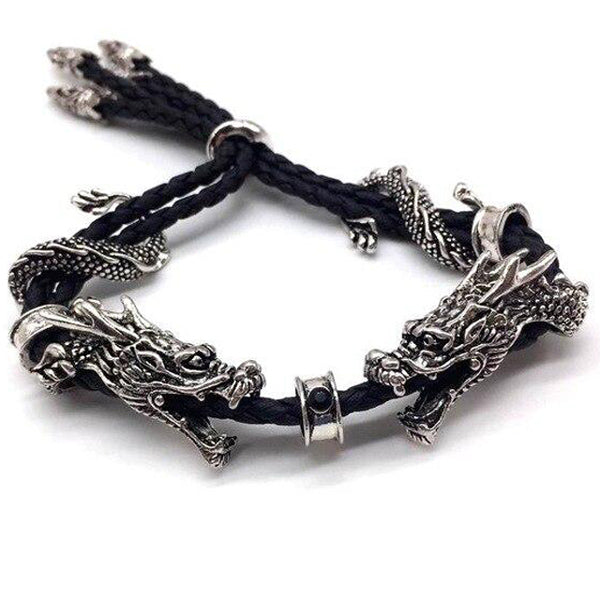
Meaning of the Viking Dragon Bracelet
Viking bracelets weren't just decorative objects; they held a much deeper meaning. These pieces of jewelry were popular among men, easily portable, and protective. Here are the different meanings of the Viking dragon bracelet :
- Rite of passage : In Viking culture and tradition, a bracelet was given to a boy who had reached manhood.
- Memories : When a Viking was preparing to go to sea, they would make a bracelet for his wife as a symbol of their love.
- Currency : In a time when fiat money (coins and paper) did not exist, Viking bracelets were used as currency.
- Oath : Lords and warriors swore oaths of allegiance and loyalty to each other until their death using Viking bracelets.

The dragon motifs on Viking bracelets may appear purely decorative, but remember the Norse beliefs and creatures; we believe they would influence these jewels by incorporating their mystical characteristics .
Today, Viking dragon bracelets are worn by both women and men ; they are distinguished and elegant , exuding a mysterious and captivating air. Having traversed numerous cultures worldwide, the concept of the Viking dragon bracelet remains relevant. With the incorporation of new artistic expressions, the bracelets and their designs continue to evolve and change.
Drakkar: The Vikings' Dragon Ship
To clear up any confusion, the word " drakkar " was actually coined by the French in the 19th century, perhaps inspired by the word " dreki " (drekar in the plural, which means dragon in Old Norse). The aim was to name, and give a Scandinavian sound to, Viking ships adorned with a dragon figurehead. These Viking ships are described as elegant and uniquely decorated. They were used by warriors who carried out raids and plundered.

The prows of Viking longships were adorned with carvings of menacing beasts, such as dragons or serpents, intended to protect the ship and its crew. One of the symbolisms of the Viking longship was to ward off the terrible sea monsters of Norse mythology. It is likely that these carvings had a ritual purpose and that the effect produced was meant to frighten enemies and the inhabitants of future raided towns.

In short, the longship was a symbol of war intended to ward off evil spirits and instill fear in enemies during Viking raids from the sea. Highly practical in naval battles , Viking longships were long, light, and sleek, facilitating rapid movement. The Vikings also used the dragon as a symbol of strength on their shields, ships, jewelry, and sculptures.
Gain the Powers of a Viking Dragon!
We learned quite a bit about the presence and role of the Viking dragon among the Nordic peoples. Although portrayed as malevolent in myths, Scandinavian dragons, in the modern sense of the term, represent the cycle of beginning and end. They are also guardians of treasures, whether gold in the literal sense or wisdom in the figurative sense.
Viking dragons will forever remain a mystery in the hearts and minds of humanity. Now, the choice is yours to take the plunge and adorn yourself with one of our fabulous Viking dragon rings . Simply click on the image. 👇