Yin Yang Dragon

Why is the dragon sometimes depicted with the Yin Yang symbol? Are dragons Yin or Yang? What do the tiger and the dragon symbolize in Yin Yang? What do the dragon and the phoenix symbolize in Yin Yang?
Many questions related to Chinese philosophy that we will answer. To fully understand the different meanings of the Dragon in the Yin Yang, we must first unravel the mysteries surrounding the yin yang symbol and its history. ☯
Before moving on, like many others, discover and purchase one of our sublime Dragon Kimonos below. Very light and relaxed, they are designed in a style reflecting Japanese art.

Meaning of Yin and Yang
Yin and Yang (or yin-yang) is a complex relational concept in Chinese culture that has developed over thousands of years. The meaning of yin and yang is that the universe is governed by a cosmic duality, that is, by a set of two opposing and complementary cosmic principles or energies that can be observed in nature.
- Yin-yang philosophy says that the universe is composed of opposing and complementary forces of darkness and light, sun and moon, man and woman.
- This philosophy, at least 3,500 years old, is discussed in the ninth century BC text known as the Yi Ching or Book of Changes, and it influences the philosophies of Taoism and Confucianism.
- The yin-yang symbol refers to the ancient method used to track the movements of the sun, moon, and stars throughout the year.

In general, Yin is characterized as an internal, feminine energy—still, dark, and negative. Yang , on the other hand, is characterized as an external, masculine energy—hot, bright, and positive. The balance between Yin and Yang is important. If Yin is stronger, Yang will be weaker, and vice versa. Yin and Yang can interact under certain conditions to prevent them from becoming isolated. Elements of Yin may contain aspects of Yang, and Yang may have components of Yin. This balance between Yin and Yang is perceived as existing in all things.
Yin Yang Symbol
The Yin-Yang symbol (also known as the Tai Chi symbol ) consists of a circle divided in half by a curved line. One half of the circle is black, generally representing the yin side, and the other is white, representing the yang side. A dot of each color is located near the center of the opposite half. The two halves thus intertwine in a spiral-like curve that divides the whole into semicircles, and the small dots represent the idea that each side carries the seed of the other.

The white dot within the black area and the black dot within the white area evoke the coexistence and unity of opposites to form a whole. The curved line signifies that there is no absolute separation between the two opposites. The yin and yang symbol thus embodies both sides: duality, paradox, unity in diversity, change, and harmony.
Origin of the Yin Yang Symbol
The origin of the Yin Yang symbol lies in the ancient Chinese system of timekeeping, which involved using a stick to measure the variations in the length of shadows throughout the solar year. It was invented in China at least 600 years before Christ.

Yin and yang also represent the observation of the Earth's shadow on the moon and the recording of the position of the Big Dipper constellation throughout the year. These observations constitute the four cardinal points of the compass: the sun rises in the east and sets in the west, the direction of the shortest measured shadow is south, and at night, Polaris points north. Thus, yin and yang are fundamentally linked to the Earth's annual cycle around the sun and the resulting four seasons.
Origin of Yin Yang
The concept of Yin and Yang has a long history. Numerous written records exist on Yin and Yang, some dating back to the Yin Dynasty (c. 1400–1100 BCE) and the Western Zhou Dynasty (1100–771 BCE). The earliest known texts on the Yin-Yang principle are found in the Zhouyi, also known as the Yi Ching or Book of Changes, which was written by King Wen in the 9th century BCE during the Western Zhou Dynasty.

The Jing section of Zhouyi speaks particularly of the flow of yin and yang in nature. The concept became increasingly popular during the Spring and Autumn period (770-476 BC) and the Warring States period (475-221 BC) in ancient Chinese history.

The story of Yin and Yang has influenced thousands of years of Chinese philosophers, including scholars associated with Taoism like Lao Tzu (571-447 BC) and Confucianism like Confucius himself (557-479 BC). It forms the basis of martial arts, medicine, science, literature, politics, daily behavior, beliefs, and intellectual pursuits in Asia.
Meaning of the Dragon in Yin Yang
The principles of Feng Shui and Yin Yang are closely linked to Chinese astrology, and dragons hold an important place in the Chinese zodiac. The dragon is believed to be associated with the moon. In Chinese astrology, the dragon appears through the symbols of the lunar nodes. Their shape resembles a horseshoe, with a small circle at each end. One end represents the dragon's head . This energy pulls things forward, toward the future. The other end represents the dragon's tail , and this end tends to pull things back into the past.

The interaction of energy between the Yin and Yang Dragons is symbiotic. Together, they generate the flow of chi energy, which sets the universe in motion. It takes the energy of two dragons, each following the other's tail, to maintain the balance of things. Ultimately, yin and yang come into play whenever a conflict arises.
Role of the Yin Yang Dragon
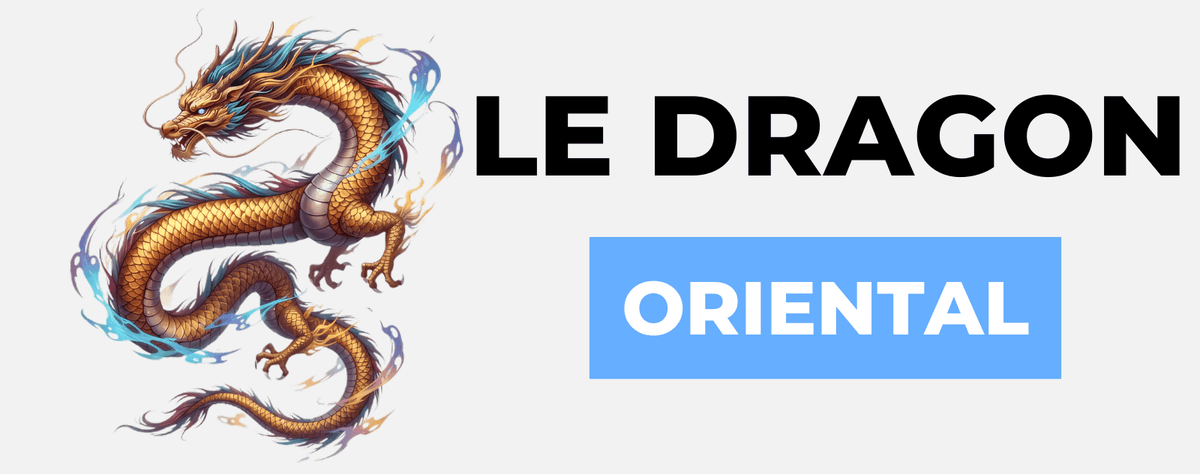
The Yin Yang Dragon is one of the many variations of the Yin Yang symbol. Dragons are awe-inspiring and benevolent mystical creatures in Chinese culture. Their role is to bring strength, luck, and prosperity to those who accept and fully utilize their energies. There are two types of dragons, depending on the nature of the power they embody: some carry Yin, and others carry Yang. 🐉

Yang Dragons
Yang Dragons are wingless incarnations characterized by their positive energy, radiant light, warmth, and masculine appearance. The Yang Dragon is energetic, active, and impulsive. Driven by courage and bravery, it acts without considering the consequences. Influenced by the planet Mars , the Yang Dragon is virile, bold, and extroverted. It exudes an active and reckless energy. This magical creature's impulsiveness must be restrained to prevent great havoc. The Yin partner must intervene to help counterbalance the Yang Dragon's excesses.

Yin Dragons
The characteristics and energy of Yin Dragons are the opposite of those of Yang Dragons. Their qualities include negative energy, darkness, coldness, and a feminine aspect. This supernatural being is depicted with wings. The planet Venus greatly influences the Yin Dragon, making its energy reflective, observant, and enduring. While the Yang Dragon has an impulsive nature, the Yin Dragon is characterized by meditation, resilience, and reasoning in situations. Both are necessary to maintain balance; they cannot exist without each other.

Relationship between Yin and Yang Dragons
The Yin and Yang dragons merge their energies to maintain the harmony of the universe . The fiery Yang guides the contemplative Yin to action, and the instinctive Yin advises the impetuous Yang; they help each other choose the wisest paths and ways. Together, they generate the ebb and flow of energy that sustains the universe, the cosmos, and all beings within it. This energy flow is known as Chi, and it is the foundational principle of Feng Shui.

Symbolism of the Tiger and Dragon Yin Yang
The tiger and the dragon are celestial enemies . They are both powerful animals in Chinese folklore . The tiger represents yin (female), and the dragon yang (male). They play an important role in Chinese martial arts, illustrating the rivalry between the two. The fundamental purpose of Chi energy is to maintain the balance between these two opposing forces. The dragon is offensive in nature, while the tiger is more defensive. The dragon represents spirit and heaven, and the tiger represents matter and earth. Here is an illustration of the Tiger Dragon Yin Yang .

The dragon is the celestial guardian of the East (the constellation of Azure Dragons in the East), while the white tiger is the celestial guardian of the West (the constellation of White Tigers in the West). Dragons and tigers are traditional enemies. The dragon has a long history in Chinese culture, representing the Chinese emperor, descendants of dragon gods, and those claiming royal blood. The tiger, which opposes the dragon, is known to bring good fortune and prosperity. The Tiger and Dragon Yin Yang symbol is important in Feng Shui (the ancient Chinese art of balancing the energies of surrounding areas), and is believed to safeguard the health and wealth of a family.

To try and maintain order and balance, the earth, held hostage by the dragon, was challenged by the tiger. The tiger restored the world's balance through the energies of yin and yang chi, removing half of the dragon's power. This is precisely the goal of Feng Shui: to maintain the balance of energies around your home. 🐅

Symbolism of the Dragon and Phoenix Yin Yang
The Dragon, Phoenix, Yin, and Yang symbolize the perfect harmony of a loving couple, ideal balance, happiness with your partner, and the unbreakable stability of their union. The Dragon and the Phoenix, together with the Yin-Yang symbol, represent the duality of all that exists, the fundamental forces that oppose and those that complement each other. Yin is the feminine principle, representing earth, darkness, inertia, and absorption. Yang is the masculine principle, representing heaven, light, action, and penetration.

The Azure Dragon and the Red Phoenix are among the four celestial guardians in Chinese mythology and Feng Shui. The Dragon is the guardian of the East, while the Phoenix is the guardian of the South. The Dragon is complemented by the Phoenix; they balance and attract each other. Without the Phoenix, there is no creation or infinite renewal of life, and without the Dragon, there is neither order nor balance. Together, they represent the Tao , which is the primordial and fundamental essence of the universe, the natural order of existence in all its forms. The symbol of the Dragon and the Phoenix, linked to Yin Yang, represents eternal love , a perpetual union in symbiosis, where they complement each other.

In summary, the Dragon and Phoenix are symbols of infinite love in Feng Shui. If you are searching for your soulmate and true love, don't miss this opportunity; the phoenix and dragon will accompany you on your quest for happiness with your partner. The Dragon Phoenix symbol will help you achieve a stable and peaceful home by emitting positive vibrations and energies.

Meaning of the Yin Yang Dragon Tattoo
The Yin Yang Dragon Tattoo unites two spiritual symbols, representing balanced energy. The design is inspired by Chinese culture, in which yin and yang constitute two opposing energetic forces. Yin is passive, feminine, and associated with cold, while yang is active, masculine, and associated with heat. When perfectly united, they represent a complete and balanced universe. Dragons also represent the forces of nature in Chinese culture. When depicted with the yin and yang symbol, it signifies that life itself is in harmony.

Yin Yang Dragon Wall Decoration
We've just explored the various symbolic meanings of the Dragon in Feng Shui , particularly the Yin Yang . Deeply rooted in Chinese culture, the Yin Yang Dragon is a powerful symbol that you should also have in your home. Beyond its decorative appeal, displaying a Dragon combined with Yin Yang can only be positive, given all the benefits it has offered for so many years.
Take the plunge and get one of our Dragon Stickers ! Below, as mentioned earlier in the article, is the Tiger and Dragon Sticker. A must-have for wall decor, it creates a welcoming atmosphere and harmonizes the energies in your home. 🏘